EMT Practice Test

1. Question Content...


Question List

Question1: Suppose you have a table that includes a nested column called "city" inside a column called "person", but when you try to submit the following query in BigQuery, it gives you an error.
SELECT person FROM `project1.example.table1` WHERE city = "London"
How would you correct the error?

Question2: To run a TensorFlow training job on your own computer using Cloud Machine Learning Engine, what would your command start with?

Question3: An online brokerage company requires a high volume trade processing architecture. You need to create a secure queuing system that triggers jobs. The jobs will run in Google Cloud and cat the company's Python API to execute trades. You need to efficiently implement a solution. What should you do?

Question4: You are building a new application that you need to collect data from in a scalable way. Data arrives continuously from the application throughout the day, and you expect to generate approximately 150 GB of JSON data per day by the end of the year. Your requirements are:
Decoupling producer from consumer
Space and cost-efficient storage of the raw ingested data, which is to be stored indefinitely
Near real-time SQL query
Maintain at least 2 years of historical data, which will be queried with SQ
Which pipeline should you use to meet these requirements?

Question5: You have Cloud Functions written in Node.js that pull messages from Cloud Pub/Sub and send the data to BigQuery. You observe that the message processing rate on the Pub/Sub topic is orders of magnitude higher than anticipated, but there is no error logged in Stackdriver Log Viewer. What are the two most likely causes of this problem? Choose 2 answers.

Question6: You create a new report for your large team in Google Data Studio 360. The report uses Google BigQuery as its data source. It is company policy to ensure employees can view only the data associated with their region, so you create and populate a table for each region. You need to enforce the regional access policy to the data.
Which two actions should you take? (Choose two.)

Question7: What are the minimum permissions needed for a service account used with Google Dataproc?

Question8: You are integrating one of your internal IT applications and Google BigQuery, so users can query BigQuery from the application's interface. You do not want individual users to authenticate to BigQuery and you do not want to give them access to the dataset. You need to securely access BigQuery from your IT application.
What should you do?

Question9: You are building new real-time data warehouse for your company and will use Google BigQuery streaming inserts. There is no guarantee that data will only be sent in once but you do have a unique ID for each row of data and an event timestamp. You want to ensure that duplicates are not included while interactively querying dat
a. Which query type should you use?

Question10: The YARN ResourceManager and the HDFS NameNode interfaces are available on a Cloud Dataproc cluster ____.

Question11: You are migrating a table to BigQuery and are deeding on the data model. Your table stores information related to purchases made across several store locations and includes information like the time of the transaction, items purchased, the store ID and the city and state in which the store is located You frequently query this table to see how many of each item were sold over the past 30 days and to look at purchasing trends by state city and individual store. You want to model this table to minimize query time and cost. What should you do?

Question12: Which of these statements about BigQuery caching is true?

Question13: Your globally distributed auction application allows users to bid on items. Occasionally, users place identical bids at nearly identical times, and different application servers process those bids. Each bid event contains the item, amount, user, and timestamp. You want to collate those bid events into a single location in real time to determine which user bid first. What should you do?

Question14: Which of the following job types are supported by Cloud Dataproc (select 3 answers)?

Question15: Your weather app queries a database every 15 minutes to get the current temperature. The frontend is powered by Google App Engine and server millions of users. How should you design the frontend to respond to a database failure?

Question16: You have an Apache Kafka Cluster on-prem with topics containing web application logs. You need to replicate the data to Google Cloud for analysis in BigQuery and Cloud Storage. The preferred replication method is mirroring to avoid deployment of Kafka Connect plugins.
What should you do?

Question17: You store historic data in Cloud Storage. You need to perform analytics on the historic dat
a. You want to use a solution to detect invalid data entries and perform data transformations that will not require programming or knowledge of SQL.
What should you do?

Question18: Which methods can be used to reduce the number of rows processed by BigQuery?

Question19: Cloud Bigtable is a recommended option for storing very large amounts of ____________________________?

Question20: Your team is responsible for developing and maintaining ETLs in your company. One of your Dataflow jobs is failing because of some errors in the input data, and you need to improve reliability of the pipeline (incl. being able to reprocess all failing data).
What should you do?

Question21: Suppose you have a dataset of images that are each labeled as to whether or not they contain a human face. To create a neural network that recognizes human faces in images using this labeled dataset, what approach would likely be the most effective?

Question22: How would you query specific partitions in a BigQuery table?

Question23: You are using BigQuery and Data Studio to design a customer-facing dashboard that displays large quantities of aggregated dat
a. You expect a high volume of concurrent users. You need to optimize tie dashboard to provide quick visualizations with minimal latency. What should you do?

Question24: You launched a new gaming app almost three years ago. You have been uploading log files from the previous day to a separate Google BigQuery table with the table name format LOGS_yyyymmdd. You have been using table wildcard functions to generate daily and monthly reports for all time ranges. Recently, you discovered that some queries that cover long date ranges are exceeding the limit of 1,000 tables and failing. How can you resolve this issue?

Question25: The Dataflow SDKs have been recently transitioned into which Apache service?

Question26: You are designing storage for two relational tables that are part of a 10-TB database on Google Cloud. You want to support transactions that scale horizontally. You also want to optimize data for range queries on nonkey columns. What should you do?

Question27: You are a retailer that wants to integrate your online sales capabilities with different in-home assistants, such as Google Home. You need to interpret customer voice commands and issue an order to the backend systems. Which solutions should you choose?

Question28: You currently have a single on-premises Kafka cluster in a data center in the us-east region that is responsible for ingesting messages from IoT devices globally. Because large parts of globe have poor internet connectivity, messages sometimes batch at the edge, come in all at once, and cause a spike in load on your Kafka cluster. This is becoming difficult to manage and prohibitively expensive. What is the Google-recommended cloud native architecture for this scenario?

Question29: Your company is running their first dynamic campaign, serving different offers by analyzing real-time data during the holiday season. The data scientists are collecting terabytes of data that rapidly grows every hour during their 30-day campaign. They are using Google Cloud Dataflow to preprocess the data and collect the feature (signals) data that is needed for the machine learning model in Google Cloud Bigtable. The team is observing suboptimal performance with reads and writes of their initial load of 10 TB of dat
a. They want to improve this performance while minimizing cost. What should they do?

Question30: You have a query that filters a BigQuery table using a WHERE clause on timestamp and ID columns. By using bq query - -dry_run you learn that the query triggers a full scan of the table, even though the filter on timestamp and ID select a tiny fraction of the overall dat
a. You want to reduce the amount of data scanned by BigQuery with minimal changes to existing SQL queries. What should you do?

Question31: These primary tool in use, and the data format is Optimized Row Columnar (ORC). All ORC files have been successfully copied to a Cloud Storage bucket. You need to replicate some data to the cluster's local Hadoop Distributed File System (HDFS) to maximize performance. What are two ways to start using Hive in Cloud Dataproc? (Choose two.)

Question32: Your analytics team wants to build a simple statistical model to determine which customers are most likely to work with your company again, based on a few different metrics. They want to run the model on Apache Spark, using data housed in Google Cloud Storage, and you have recommended using Google Cloud Dataproc to execute this job. Testing has shown that this workload can run in approximately 30 minutes on a 15-node cluster, outputting the results into Google BigQuery. The plan is to run this workload weekly. How should you optimize the cluster for cost?

Question33: Your United States-based company has created an application for assessing and responding to user actions. The primary table's data volume grows by 250,000 records per second. Many third parties use your application's APIs to build the functionality into their own frontend applications. Your application's APIs should comply with the following requirements:
* Single global endpoint
* ANSI SQL support
* Consistent access to the most up-to-date data
What should you do?

Question34: Flowlogistic's management has determined that the current Apache Kafka servers cannot handle the data volume for their real-time inventory tracking system. You need to build a new system on Google Cloud Platform (GCP) that will feed the proprietary tracking software. The system must be able to ingest data from a variety of global sources, process and query in real-time, and store the data reliably. Which combination of GCP products should you choose?

Question35: All Google Cloud Bigtable client requests go through a front-end server ______ they are sent to a Cloud Bigtable node.

Question36: You are building a new data pipeline to share data between two different types of applications: jobs generators and job runners. Your solution must scale to accommodate increases in usage and must accommodate the addition of new applications without negatively affecting the performance of existing ones. What should you do?

Question37: You designed a database for patient records as a pilot project to cover a few hundred patients in three clinics. Your design used a single database table to represent all patients and their visits, and you used self-joins to generate reports. The server resource utilization was at 50%. Since then, the scope of the project has expanded. The database must now store 100 times more patient records. You can no longer run the reports, because they either take too long or they encounter errors with insufficient compute resources. How should you adjust the database design?

Question38: What are two of the benefits of using denormalized data structures in BigQuery?

Question39: What is the HBase Shell for Cloud Bigtable?

Question40: An external customer provides you with a daily dump of data from their database. The data flows into Google Cloud Storage GCS as comma-separated values (CSV) files. You want to analyze this data in Google BigQuery, but the data could have rows that are formatted incorrectly or corrupted. How should you build this pipeline?

Question41: You need to copy millions of sensitive patient records from a relational database to BigQuery. The total size of the database is 10 TB. You need to design a solution that is secure and time-efficient. What should you do?

Question42: You need to create a near real-time inventory dashboard that reads the main inventory tables in your BigQuery data warehouse. Historical inventory data is stored as inventory balances by item and location. You have several thousand updates to inventory every hour. You want to maximize performance of the dashboard and ensure that the data is accurate. What should you do?

Question43: Your company is selecting a system to centralize data ingestion and delivery. You are considering messaging and data integration systems to address the requirements. The key requirements are:
* The ability to seek to a particular offset in a topic, possibly back to the start of all data ever captured
* Support for publish/subscribe semantics on hundreds of topics
* Retain per-key ordering
Which system should you choose?

Question44: You have a petabyte of analytics data and need to design a storage and processing platform for it. You must be able to perform data warehouse-style analytics on the data in Google Cloud and expose the dataset as files for batch analysis tools in other cloud providers. What should you do?

Question45: Your company is performing data preprocessing for a learning algorithm in Google Cloud Dataflow. Numerous data logs are being are being generated during this step, and the team wants to analyze them. Due to the dynamic nature of the campaign, the data is growing exponentially every hour.
The data scientists have written the following code to read the data for a new key features in the logs.
BigQueryIO.Read
.named("ReadLogData")
.from("clouddataflow-readonly:samples.log_data")
You want to improve the performance of this data read. What should you do?

Question46: Which of the following are examples of hyperparameters? (Select 2 answers.)

Question47: You want to optimize your queries for cost and performance. How should you structure your data?

Question48: You need to set access to BigQuery for different departments within your company. Your solution should comply with the following requirements:
* Each department should have access only to their data.
* Each department will have one or more leads who need to be able to create and update tables and provide them to their team.
* Each department has data analysts who need to be able to query but not modify data.
How should you set access to the data in BigQuery?

Question49: Which of these are examples of a value in a sparse vector? (Select 2 answers.)

Question50: Your company has a hybrid cloud initiative. You have a complex data pipeline that moves data between cloud provider services and leverages services from each of the cloud providers. Which cloud-native service should you use to orchestrate the entire pipeline?

Question51: If you're running a performance test that depends upon Cloud Bigtable, all the choices except one below are recommended steps. Which is NOT a recommended step to follow?

Question52: You are migrating your data warehouse to BigQuery. You have migrated all of your data into tables in a dataset. Multiple users from your organization will be using the dat
a. They should only see certain tables based on their team membership. How should you set user permissions?

Question53: Which of the following statements is NOT true regarding Bigtable access roles?

Question54: Cloud Bigtable is Google's ______ Big Data database service.

Question55: Cloud Dataproc is a managed Apache Hadoop and Apache _____ service.

Question56: The _________ for Cloud Bigtable makes it possible to use Cloud Bigtable in a Cloud Dataflow pipeline.

Question57: You need ads data to serve Al models and historical data tor analytics longtail and outlier data points need to be identified You want to cleanse the data n near-reel time before running it through Al models What should you do?

Question58: A live TV show asks viewers to cast votes using their mobile phones. The event generates a large volume of data during a 3 minute period. You are in charge of the Voting restructure* and must ensure that the platform can handle the load and Hal all votes are processed. You must display partial results write voting is open. After voting doses you need to count the votes exactly once white optimizing cost. What should you do?

Question59: You are selecting services to write and transform JSON messages from Cloud Pub/Sub to BigQuery for a data pipeline on Google Cloud. You want to minimize service costs. You also want to monitor and accommodate input data volume that will vary in size with minimal manual intervention. What should you do?

Question60: When running a pipeline that has a BigQuery source, on your local machine, you continue to get permission denied errors. What could be the reason for that?

Question61: You work for a bank. You have a labelled dataset that contains information on already granted loan application and whether these applications have been defaulted. You have been asked to train a model to predict default rates for credit applicants.
What should you do?

Question62: You use a dataset in BigQuery for analysis. You want to provide third-party companies with access to the same dataset. You need to keep the costs of data sharing low and ensure that the data is current. Which solution should you choose?

Question63: For the best possible performance, what is the recommended zone for your Compute Engine instance and Cloud Bigtable instance?

Question64: You are designing storage for very large text files for a data pipeline on Google Cloud. You want to support ANSI SQL queries. You also want to support compression and parallel load from the input locations using Google recommended practices. What should you do?

Question65: You have spent a few days loading data from comma-separated values (CSV) files into the Google BigQuery table CLICK_STREAM. The column DT stores the epoch time of click events. For convenience, you chose a simple schema where every field is treated as the STRING type. Now, you want to compute web session durations of users who visit your site, and you want to change its data type to the TIMESTAMP. You want to minimize the migration effort without making future queries computationally expensive. What should you do?

Question66: After migrating ETL jobs to run on BigQuery, you need to verify that the output of the migrated jobs is the same as the output of the original. You've loaded a table containing the output of the original job and want to compare the contents with output from the migrated job to show that they are identical. The tables do not contain a primary key column that would enable you to join them together for comparison.
What should you do?

Question67: You need to choose a database for a new project that has the following requirements:
* Fully managed
* Able to automatically scale up
* Transactionally consistent
* Able to scale up to 6 TB
* Able to be queried using SQL
Which database do you choose?

Question68: You want to rebuild your batch pipeline for structured data on Google Cloud You are using PySpark to conduct data transformations at scale, but your pipelines are taking over twelve hours to run To expedite development and pipeline run time, you want to use a serverless tool and SQL syntax You have already moved your raw data into Cloud Storage How should you build the pipeline on Google Cloud while meeting speed and processing requirements?

Question69: If you want to create a machine learning model that predicts the price of a particular stock based on its recent price history, what type of estimator should you use?

Question70: A shipping company has live package-tracking data that is sent to an Apache Kafka stream in real time. This is then loaded into BigQuery. Analysts in your company want to query the tracking data in BigQuery to analyze geospatial trends in the lifecycle of a package. The table was originally created with ingest-date partitioning. Over time, the query processing time has increased. You need to implement a change that would improve query performance in BigQuery. What should you do?

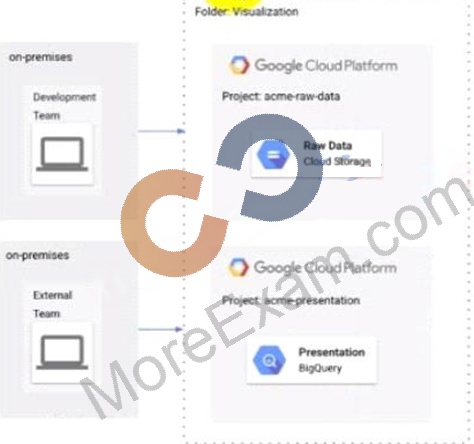
Question71: The Development and External teams nave the project viewer Identity and Access Management (1AM) role m a folder named Visualization. You want the Development Team to be able to read data from both Cloud Storage and BigQuery, but the External Team should only be able to read data from BigQuery. What should you do?

Question72: What is the general recommendation when designing your row keys for a Cloud Bigtable schema?

Question73: What is the recommended action to do in order to switch between SSD and HDD storage for your Google Cloud Bigtable instance?

Question74: Which role must be assigned to a service account used by the virtual machines in a Dataproc cluster so they can execute jobs?

Question75: You are planning to migrate your current on-premises Apache Hadoop deployment to the cloud. You need to ensure that the deployment is as fault-tolerant and cost-effective as possible for long-running batch jobs. You want to use a managed service. What should you do?

Question76: Your company receives both batch- and stream-based event dat
a. You want to process the data using Google Cloud Dataflow over a predictable time period. However, you realize that in some instances data can arrive late or out of order. How should you design your Cloud Dataflow pipeline to handle data that is late or out of order?

Question77: You're using Bigtable for a real-time application, and you have a heavy load that is a mix of read and writes. You've recently identified an additional use case and need to perform hourly an analytical job to calculate certain statistics across the whole database. You need to ensure both the reliability of your production application as well as the analytical workload.
What should you do?

Question78: Your company uses a proprietary system to send inventory data every 6 hours to a data ingestion service in the cloud. Transmitted data includes a payload of several fields and the timestamp of the transmission. If there are any concerns about a transmission, the system re-transmits the dat
a. How should you deduplicate the data most efficiency?

Question79: You are working on a sensitive project involving private user dat
a. You have set up a project on Google Cloud Platform to house your work internally. An external consultant is going to assist with coding a complex transformation in a Google Cloud Dataflow pipeline for your project. How should you maintain users' privacy?

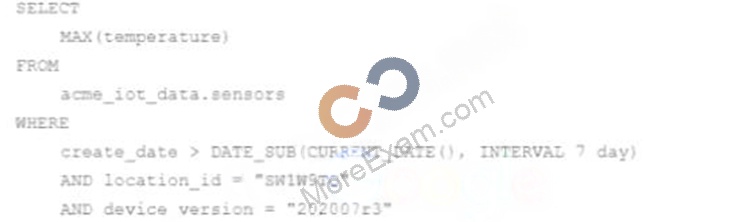
Question80: You are collecting loT sensor data from millions of devices across the world and storing the data in BigQuery. Your access pattern is based on recent data tittered by location_id and device_version with the following query:

You want to optimize your queries for cost and performance. How should you structure your data?

Question81: You are running a pipeline in Cloud Dataflow that receives messages from a Cloud Pub/Sub topic and writes the results to a BigQuery dataset in the EU. Currently, your pipeline is located in europe-west4 and has a maximum of 3 workers, instance type n1-standard-1. You notice that during peak periods, your pipeline is struggling to process records in a timely fashion, when all 3 workers are at maximum CPU utilization. Which two actions can you take to increase performance of your pipeline? (Choose two.)

Question82: Given the record streams MJTelco is interested in ingesting per day, they are concerned about the cost of Google BigQuery increasing. MJTelco asks you to provide a design solution. They require a single large data table called tracking_table. Additionally, they want to minimize the cost of daily queries while performing fine-grained analysis of each day's events. They also want to use streaming ingestion. What should you do?

Question83: You are working on a niche product in the image recognition domain. Your team has developed a model that is dominated by custom C++ TensorFlow ops your team has implemented. These ops are used inside your main training loop and are performing bulky matrix multiplications. It currently takes up to several days to train a model. You want to decrease this time significantly and keep the cost low by using an accelerator on Google Cloud. What should you do?

Question84: The marketing team at your organization provides regular updates of a segment of your customer dataset. The marketing team has given you a CSV with 1 million records that must be updated in BigQuery. When you use the UPDATE statement in BigQuery, you receive a quotaExceeded error. What should you do?

Question85: MJTelco is building a custom interface to share dat
a. They have these requirements:
They need to do aggregations over their petabyte-scale datasets.
They need to scan specific time range rows with a very fast response time (milliseconds).
Which combination of Google Cloud Platform products should you recommend?

Question86: What Dataflow concept determines when a Window's contents should be output based on certain criteria being met?

Question87: You are building a data pipeline on Google Cloud. You need to prepare data using a casual method for a
machine-learning process. You want to support a logistic regression model. You also need to monitor and
adjust for null values, which must remain real-valued and cannot be removed. What should you do?

Question88: Your company has recently grown rapidly and now ingesting data at a significantly higher rate than it was previously. You manage the daily batch MapReduce analytics jobs in Apache Hadoop. However, the recent increase in data has meant the batch jobs are falling behind. You were asked to recommend ways the development team could increase the responsiveness of the analytics without increasing costs. What should you recommend they do?

Question89: As your organization expands its usage of GCP, many teams have started to create their own projects. Projects are further multiplied to accommodate different stages of deployments and target audiences. Each project requires unique access control configurations. The central IT team needs to have access to all projects. Furthermore, data from Cloud Storage buckets and BigQuery datasets must be shared for use in other projects in an ad hoc way. You want to simplify access control management by minimizing the number of policies. Which two steps should you take? Choose 2 answers.

Question90: You have a data pipeline that writes data to Cloud Bigtable using well-designed row keys. You want to monitor your pipeline to determine when to increase the size of you Cloud Bigtable cluster. Which two actions can you take to accomplish this? Choose 2 answers.

Question91: Which of the following statements about the Wide & Deep Learning model are true? (Select 2 answers.)

Question92: Your neural network model is taking days to train. You want to increase the training speed. What can you do?

Question93: Which of the following is not true about Dataflow pipelines?

Question94: Data Analysts in your company have the Cloud IAM Owner role assigned to them in their projects to allow them to work with multiple GCP products in their projects. Your organization requires that all BigQuery data access logs be retained for 6 months. You need to ensure that only audit personnel in your company can access the data access logs for all projects. What should you do?

Question95: You are creating a model to predict housing prices. Due to budget constraints, you must run it on a single resource-constrained virtual machine. Which learning algorithm should you use?

Question96: Cloud Dataproc charges you only for what you really use with _____ billing.

Question97: You want to analyze hundreds of thousands of social media posts daily at the lowest cost and with the fewest steps.
You have the following requirements:
* You will batch-load the posts once per day and run them through the Cloud Natural Language API.
* You will extract topics and sentiment from the posts.
* You must store the raw posts for archiving and reprocessing.
* You will create dashboards to be shared with people both inside and outside your organization.
You need to store both the data extracted from the API to perform analysis as well as the raw social media posts for historical archiving. What should you do?